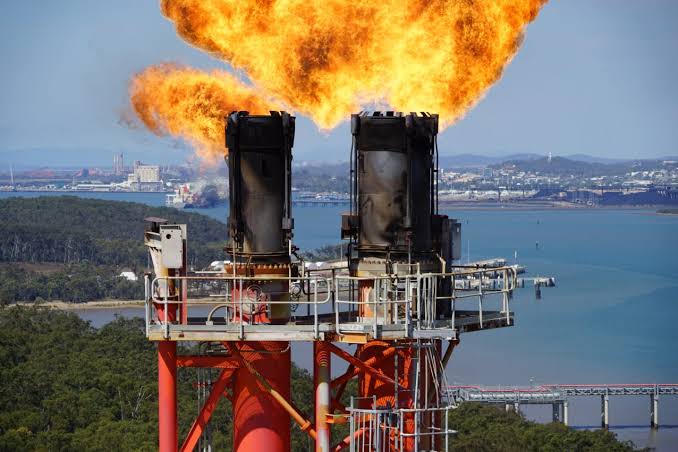
Few assets in an industrial facility are as demanding to inspect as the flare stack. Towering over a refinery or gas plant, it burns off excess gas and keeps the wider operation safe. Yet that same height and heat make it one of the hardest structures to examine. For decades, checking a flare stack meant shutting it down, raising scaffolding or sending technicians up on ropes, and accepting days of costly downtime. Every inspection also carried real risk to the people who carried it out.
Flare stack inspection is now changing, and the change is significant. A new generation of confined-space drones can examine a flare stack from top to bottom, inside and out, without a single technician leaving the ground. At ARCO Worldwide, we see this as one of the clearest examples of how aerial technology is making heavy industry both safer and more efficient.
The Challenge of the Flare Stack
A flare stack is critical safety infrastructure, and operators must keep it in sound condition. Over time, intense heat, corrosive gases, and constant weathering take their toll. The flare tip erodes. The structure fatigues. Internal linings crack and degrade. Left unchecked, any of these can lead to failure, unplanned shutdowns, or a safety incident. Regular inspection, therefore, is not optional. It is essential.
The problem has always been access. A flare stack is tall, hot, and often positioned in the middle of a live facility. Traditional inspection therefore demands difficult and expensive measures. First, operators must shut the flare down and wait for it to cool. Then they build scaffolding, bring in cranes, or send rope-access technicians to climb the structure by hand. Each option is slow, and each places workers at height in a hazardous environment. Worse still, the whole process can stretch a shutdown by days, and every idle day carries a heavy price.
A New Approach to Flare Stack Inspection
This is where the Elios 3 changes the picture. Built by Flyability, it is a collision-tolerant drone designed specifically for confined and hard-to-reach spaces. A protective carbon cage surrounds the aircraft, so it can work close to a structure, and even brush against it, without crashing. Because it navigates using onboard LiDAR rather than GPS, it performs just as well inside a stack as outside it.
For a flare stack inspection, that combination is transformative. The drone flies the full height of the structure, capturing the flare tip, the support framework, and the exterior surfaces in fine detail. When access allows, it also enters the stack interior to examine the internal lining and structure. No scaffolding is raised, and no technician climbs. Instead, a pilot on the ground guides the aircraft, while the data appears in real time.
What the Elios 3 Sees
The value of any inspection lies in the quality of its data, and here the Elios 3 excels. Its 4K camera captures fine detail, revealing the cracks, corrosion, and tip damage that matter to an integrity engineer. Alongside it, a radiometric thermal camera detects heat anomalies, exposing refractory damage, insulation failures, and hot spots that the eye alone would miss.
The aircraft also carries a LiDAR sensor that builds a precise three-dimensional model of the structure. As a result, findings become measurable, located points on an accurate map of the asset, rather than loose photographs. Powerful onboard lighting then turns the darkest interior into a clear, well-lit scene. In this way, every flight adds to a complete, time-stamped record that engineers can review, compare against past surveys, and act on with confidence.
Safer, Faster, and More Cost-Effective
The benefits of this approach are immediate. Safety comes first. By keeping technicians on the ground, a drone-based flare stack inspection removes the need to work at height or enter a confined, hazardous space. In effect, the most dangerous part of the job simply disappears.
The savings follow close behind. Because there is no scaffolding to build and little lengthy preparation, an inspection that once took days can finish in hours. Downtime shrinks, and the cost of internal inspection often falls dramatically. Meanwhile, the data captured tends to be richer than a human inspector could gather with a flashlight and a notepad, because the drone sees more, records everything, and misses nothing. Safer, faster, and cheaper rarely arrive together. Here, they do.
One Provider, Inside and Out
For operators, the real advantage is a single, complete view of an asset. ARCO Worldwide already supports the energy and industrial sectors with advanced aerial inspection across pipelines, plants, and infrastructure. Adding confined-space capability extends that reach to the places our other drones cannot go.
The result is a complete picture. Our enterprise drones inspect the outside of a facility, its corridors, its structures, and its perimeters. A confined-space platform like the Elios 3 then inspects the inside, including the tanks, the vessels, and the flare stacks that sit at the heart of the operation. So a full flare stack inspection, inside and out, becomes the work of one provider, one dataset, and one clear view of asset health.
A flare stack keeps a facility safe. Inspecting it should never put anyone at risk. With the right technology overhead and inside, it no longer has to.
Ready to make your next flare stack inspection safer and faster? Get in touch with ARCO Worldwide.