Offshore Drone Inspection in Nigeria: Safer Asset Integrity
Inspecting a flare tip traditionally means one of two things. Either you shut down the flare, or you send a rope access team alongside it.
Both options cost money, and one of them puts a person on a rope beside live equipment. Offshore drone inspection removes that trade-off entirely.
Why offshore inspection stays difficult
Offshore assets sit in the harshest environment your company operates in.
Salt corrodes steel continuously. Weather windows close without warning. Access requires boats, helicopters or scaffolding, and each of those carries cost before any inspection begins. Meanwhile, shutting down production for inspection costs more than everything else combined.
So inspections get deferred. Deferred inspections let corrosion progress unseen, and integrity problems surface later as failures rather than findings.
What aerial capture changes offshore
A drone reaches places people should not go, and it reaches them without scaffolding.
Flare tips stay lit during inspection. Topside structures, risers above the waterline, helidecks, cranes and vent stacks all become accessible within a single flight. In addition, the aircraft records everything it sees, so findings come with evidence attached.
The safety case is straightforward. Fewer rope access hours mean fewer people exposed to height, weather and live process equipment.
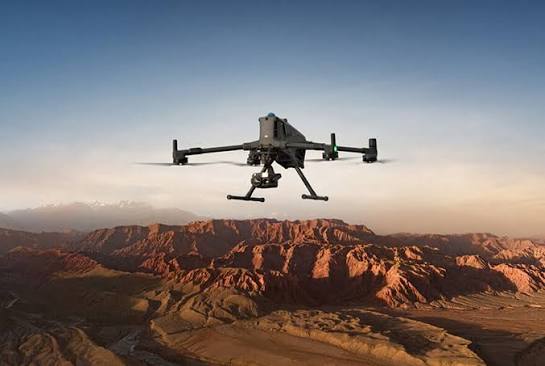
Best-fit DJI platform: Matrice 350 RTK with Zenmuse H30T
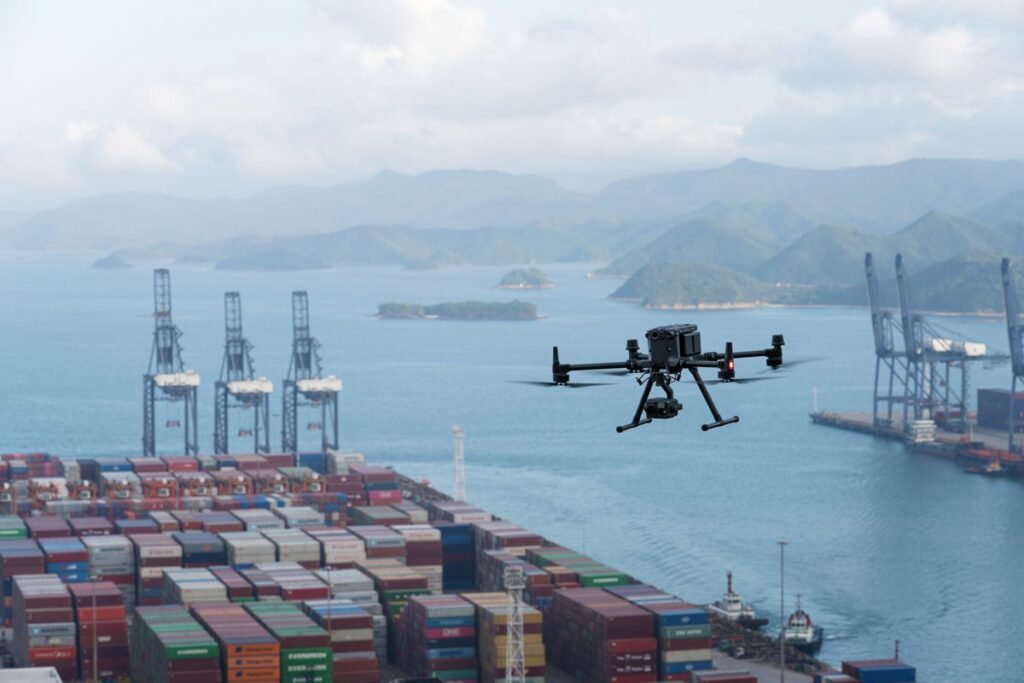
For offshore and marine work, the strongest fit in the DJI Enterprise range is the Matrice 350 RTK paired with the Zenmuse H30T.
Standoff distance matters most in this environment. The H30T’s 34x optical zoom captures weld detail, coating breakdown and corrosion from a safe distance, so the aircraft never needs to approach closely. Its laser rangefinder records exact distance to each defect, which helps engineers locate findings afterwards.
Thermal imaging adds a second layer. Heat signatures reveal insulation failures, process anomalies and electrical faults that optical cameras miss completely.
The Matrice 350 RTK itself suits the conditions. It holds position in wind, continues through rain, and carries enough endurance to work through a structure methodically rather than in rushed passes.
Smaller platforms and confined spaces
Quick assessments suit the Matrice 4T, which deploys in minutes from a deck or vessel.
Internal inspection needs something different. For tanks, caissons and other confined spaces, we deploy collision-tolerant platforms from Flyability, our OEM partner for enclosed environments.
What operators receive
Under our Drone as a Service model, ARCO Worldwide delivers:
- High-resolution imagery of topsides, flare structures and above-water risers
- Thermal analysis of insulation, process equipment and electrical systems
- Coating and corrosion condition reports with severity ranking
- 3D models and Digital Twins for asset records
- Confined space inspection of tanks and enclosed structures
- Maintenance recommendations tied to each finding
Your integrity team receives findings. We manage the aviation, the approvals and the processing.
Beyond inspection: marine operations
The same capability supports wider marine activity.
Vessel hull and superstructure assessment above the waterline happens without dry-docking. Offshore platform survey documents structures accurately. Ship escort and approach monitoring give bridge teams a view they otherwise lack, while emergency response benefits from immediate aerial assessment after an incident.
Why the standard matters offshore
Operating around live hydrocarbon assets demands proper authorisation and disciplined procedure.
ARCO Worldwide is Nigeria’s first licensed commercial drone operator, authorised by the NCAA and approved by the Office of the National Security Adviser. Our inspection reporting runs under ISO 9001:2015 certified processes.
Oil and gas is our deepest sector, and we work with operators across Nigeria’s offshore and onshore assets. As Nigeria’s only DJI Enterprise Authorized Reseller and Enterprise Solutions Partner, we deploy the right platform for each structure rather than adapting whatever is available.
Inspect without shutting down
Integrity management works best when inspection is cheap enough to do often.
Offshore drone inspection makes that possible. It keeps production running, keeps people off ropes, and turns condition monitoring into a routine activity rather than a project.
Ready to plan your next offshore campaign? Talk to ARCO Worldwide today.