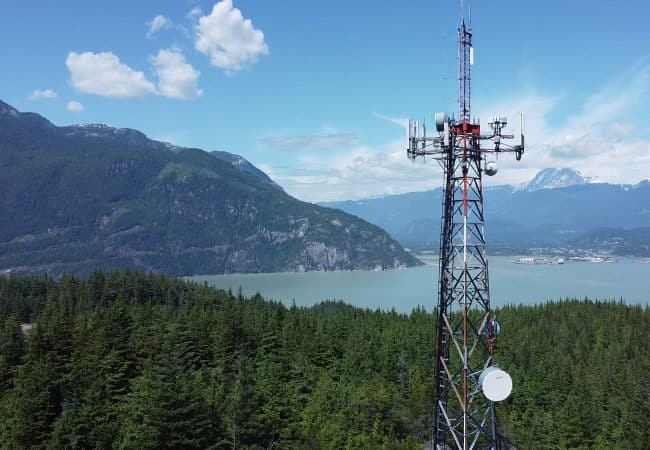
Tower inspection gets the attention. The tower is rarely what costs you money.
Steel fails slowly and visibly. The compound beneath it fails quickly and quietly, through power systems, fuel, batteries and whoever walks through the fence at night. Base station site monitoring has to cover the ground as well as the structure.
Where site costs actually go
Ask any network operations team where the budget disappears, and the tower will not be the first answer.
Diesel consumption and fuel losses lead. Generator failures follow, often from faults that showed warning signs weeks earlier. Battery degradation and rectifier issues drive replacement cycles. Equipment and cable theft removes assets outright.
Each of these shares one characteristic. They happen between site visits, at locations where visits are expensive.
Consequently, the first indication is often an outage rather than an inspection finding.
What thermal sees in a power system
Electrical faults announce themselves as heat long before they cause an outage.
A loose terminal on a distribution board runs hot. A failing rectifier module warms against its neighbours. A battery string developing a fault shows uneven temperature across cells. Cable joints build resistance, and resistance produces temperature.
None of that is visible to a technician glancing at a compound. A thermal sensor sees all of it in a single pass.
Therefore the inspection output stops being a condition note and becomes a prioritised list of components to attend before they fail.
Solar hybrid sites change the requirement
More Nigerian sites now run solar hybrid configurations, and panels introduce their own failure modes.
Hot cells, failed bypass diodes, string outages and soiling all reduce output without breaking anything visibly. A site can be underperforming for months while the generator quietly covers the shortfall and the fuel bill absorbs it.
Thermal inspection identifies which modules are failing and which strings are offline. Vegetation and shading assessment follows from the same capture.
The theft problem at remote sites
Assets disappear from remote sites precisely because they are remote.
Scheduled aerial patrols change that calculation. DJI Dock 3 with the Matrice 4TD sits on site and flies automated routes day and night, with no crew travelling. The dock carries an IP56 rating and the aircraft IP55, operating from -30°C to 50°C.
Thermal coverage extends observation through the night, when most interference happens. Change detection then compares each flight against the last, flagging vehicles, new tracks and missing equipment.
For a cluster of sites, one dock positioned centrally covers a meaningful radius, since transmission reaches up to 25 kilometres.
Best-fit platforms
Three configurations cover most site requirements.
Matrice 4T is the working default for routine site assessment. It carries wide, medium tele and long-range tele cameras alongside thermal, so compound condition, power systems and structure all get captured in one visit.
Matrice 350 RTK with the Zenmuse H30T handles detailed work. Stronger zoom, higher-grade thermal and laser ranging suit complex sites, larger solar arrays and anything requiring precise location of findings.
Mavic 3T deploys in minutes for rapid checks and incident verification, folding into a vehicle for multi-site runs.
What operators receive
Under our Drone as a Service model, ARCO Worldwide delivers:
- Thermal analysis of generators, rectifiers, batteries and distribution
- Solar array performance assessment with module-level anomaly mapping
- Compound condition, fencing and access documentation
- Fuel tank and installation condition imagery
- Scheduled night patrols with thermal coverage
- Change-detection reporting between visits
- Prioritised maintenance recommendations tied to each finding
Your operations team receives a work list. We manage the aviation and the analysis.
Why the operator matters
Many sites sit near controlled airspace, and some sit in areas requiring security clearance.
ARCO Worldwide is Nigeria’s first licensed commercial drone operator, authorised by the NCAA for nationwide commercial operations and approved by the Office of the National Security Adviser. Our inspection reporting runs under ISO 9001:2015 certified processes, and our crews train through ARCO Aviation Academy.
As Nigeria’s only DJI Enterprise Authorized Reseller and Enterprise Solutions Partner, we match the platform to the site rather than sending one aircraft everywhere. With bases in Lagos, Abuja and Port Harcourt, we support multi-site campaigns nationwide.
Watch the compound, not just the steel
A tower that stands for thirty years sits above equipment that fails in three.
Base station site monitoring works when it covers both, catches thermal faults before they become outages, and keeps watching the sites nobody can visit often.
Ready to assess your site portfolio? Talk to ARCO Worldwide today.