The industry solved aerial capture years ago. It is still working out what to do with the result.
A single campaign now produces point clouds, orthomosaics, thermal datasets and thousands of images. Somebody has to look at all of it. AI in drone inspection exists because that somebody is the bottleneck.
The volume problem nobody planned for
Early drone programmes were judged on whether the aircraft could reach the asset. That question is settled.
What replaced it is less glamorous. A tower inspection generates hundreds of images. A corridor survey generates thousands. A dock flying daily generates a dataset every single day, indefinitely.
Consequently, many operators now hold more aerial data than they can interpret. Findings sit in folders because nobody had time to review the footage from three weeks ago.
That is not an inspection programme. It is an archive.
What automation actually contributes
Three functions carry most of the practical value today.
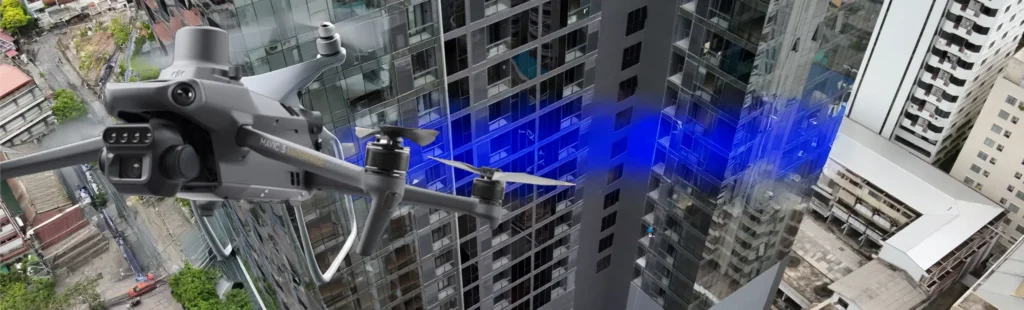
Change detection. The system compares each flight against the previous one and flags what is different. New excavation along a right of way. A vehicle where none belongs. A structure that appeared since the last pass. Through DJI FlightHub 2, that comparison runs automatically.
Object and anomaly detection. Automated routes identify vehicles, vessels and infrared temperature anomalies without anyone watching a live feed. For a DJI Dock 3 with the Matrice 4TD flying scheduled patrols, this is what makes unattended operation useful rather than merely autonomous.
Data organisation. Capture is only valuable if the right person can reach the right file. Our partnership with ROAV7 deploys the Perseus platform locally in Nigeria, giving stakeholders secure cloud access to point clouds, orthomosaics and editable inspection reports.
Together, these change the output. Instead of hours of footage, you receive a short list of what changed.
Where judgement still decides
Here is where the industry should be careful, because the claims are running ahead of the reality.
Automated detection flags candidates. It does not classify severity reliably, and it does not understand context.
A thermal anomaly on a solar panel might be a failed bypass diode, a cracked cell, soiling, or a reflection. A warm spot on a tower connector might indicate resistance, or afternoon sun on one side of the steel. Distinguishing those requires knowledge of emissivity, load conditions and time of day.
Similarly, a crack flagged on a structure is a crack. Whether it matters is an engineering judgement, informed by location, orientation, history and design.
Therefore the useful framing is assistance rather than replacement. Automation reduces what a specialist has to look at. It does not decide what the specialist concludes.
What this means for buyers
Two practical implications follow.
First, ask what the automation is actually doing. “AI-powered” describes a very wide range of capability, from genuine change detection to a filename convention. A provider should be able to explain exactly which step is automated and which is reviewed.
Second, ask who reviews the flagged items. Automated detection without qualified interpretation produces confident nonsense at scale, which is worse than a slow manual process.
The platforms behind it
Automation depends on consistent capture, which is why platform choice still matters.
DJI Dock 3 with the Matrice 4TD delivers the repeatability that change detection requires, flying the same route on schedule without a crew. The Matrice 350 RTK with the Zenmuse H30T provides the detail for verification once something is flagged. The Zenmuse P1 and L2 produce the georeferenced datasets that comparison depends on.
Inconsistent capture defeats automation entirely. If the flight path, altitude and conditions vary, comparison between dates becomes meaningless.
How we apply it
ARCO Worldwide is Nigeria’s first licensed commercial drone operator, authorised by the NCAA and approved by the Office of the National Security Adviser, with data collection and reporting under ISO 9001:2015 certified processes.
We use automation where it earns its place, and we put qualified interpretation behind every finding that reaches a client. As Nigeria’s only DJI Enterprise Authorized Reseller and Enterprise Solutions Partner, we configure the capture to support the analysis rather than the other way round.
Reduce the review, not the rigour
The value of AI in drone inspection is not that it removes people. It is that it directs their attention.
A specialist reviewing twelve flagged items finds more than one reviewing twelve hundred images. That is the whole gain, and it is substantial.
Ready to discuss an inspection programme? Talk to ARCO Worldwide today.