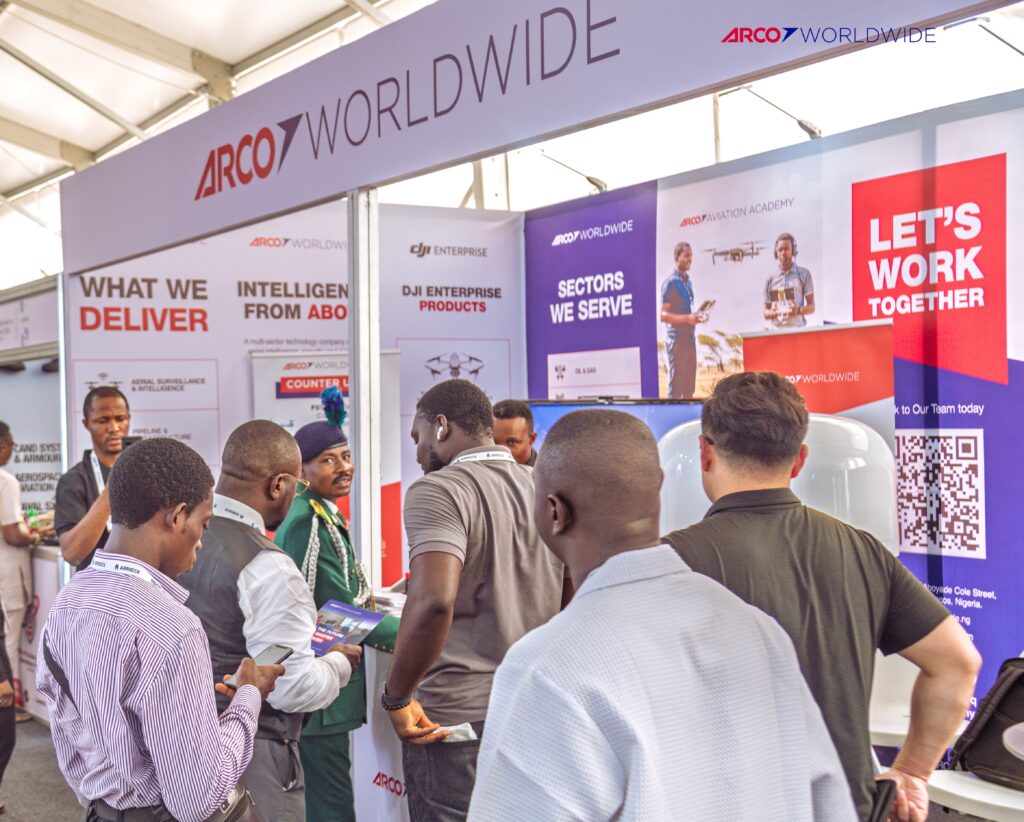
Nigeria hosted its first Africa International Defence Exhibition last week, and ARCO Worldwide was on the floor at Eko Atlantic City, Lagos.
AFRIDEX 2026 brought together defence establishments, government representatives, industry stakeholders and delegations from over 20 African countries. For a company built around unmanned aerial capability, it was the right room to be in.
What the exhibition represents
It was a maiden edition, and the framing from the opening ceremony made the intent clear.
President Bola Ahmed Tinubu, represented by Senate President Godswill Akpabio, declared Nigeria open to defence partnerships built on mutual trust and respect. He called on African partners and global innovators in artificial intelligence and emerging technologies to work with Nigeria on continental peace and stability.
The Honourable Minister of Defence, General Christopher Gwabin Musa (Rtd), OFR, went further on industry. He urged participants to invest in Nigeria’s defence sector and disclosed that massive local production of defence hardware will begin within the next year, for domestic use and for export to other African nations.
Consequently, AFRIDEX 2026 was less a trade show than a statement of direction.
Why unmanned systems belong in this conversation
Defence conversations often start with platforms and end with procurement. Aerial intelligence sits somewhere more useful.
Modern security problems are dispersed. Borders run through terrain no patrol can hold. Pipelines, transmission corridors and telecom networks cross ground nobody watches continuously. Installations need perimeters monitored after dark, when conventional observation fails.
Therefore the question is rarely whether a capability exists. It is whether anyone can see the situation in time to act on it.
That is what aerial intelligence contributes, and it applies as directly to infrastructure protection as to military operations.
What ARCO Worldwide brings to the floor
We are Nigeria’s first licensed commercial drone operator, authorised by the NCAA and approved by the Office of the National Security Adviser, operating under ISO 9001:2015 certified processes.
Our capability spans ISR-grade aerial surveillance, border and perimeter monitoring, thermal night operations, BVLOS corridor coverage, and automated dock-based systems that fly scheduled patrols without a crew on site.
Behind that sit more than 15,000 flight hours, over 70 pilots and crew, and bases in Lagos, Abuja and Port Harcourt.
We are also Nigeria’s first and only DJI Enterprise Authorized Reseller and Enterprise Solutions Partner, which means we supply and support the platforms as well as operate them.
On the stand: the DJI Matrice 400
We brought the DJI Matrice 400, and the choice was deliberate.
Defence and security requirements in Nigeria are defined by distance. A border stretch, a pipeline corridor, a transmission route or a maritime approach all demand coverage across ground that short-endurance platforms cannot reach in a single sortie.
The Matrice 400 answers that directly. Extended endurance and range mean fewer launch points along a dispersed line, fewer access trips to remote positions, and more time on station once the aircraft arrives.
Payload flexibility matters just as much. The platform carries the sensor the mission requires, so the same airframe supports long-range observation, thermal detection after dark and survey-grade mapping of terrain.
For visitors whose mandate covers wide areas rather than fixed sites, it is the most relevant platform we could have put in front of them.
The local capability argument
Local content was a recurring theme across the opening, and it is worth being precise about what it means for unmanned systems.
Hardware is the visible part. The harder part is operational: licensed crews, regulatory approvals, maintenance capability, data processing and the procedures that make a capability auditable.
An organisation can import an aircraft in weeks. Building the operation around it takes considerably longer, and that is where indigenous capacity actually sits.
ARCO Aviation Academy, our training arm and Nigeria’s first NCAA-licensed drone training institution, exists for exactly that reason. Capability that stays in the country depends on people trained here.
Partnerships, not just transactions
The President’s remarks emphasised value-driven partnership, shared knowledge and tangible outcomes. That matches how this technology actually transfers.
Aerial systems deliver value when the operating organisation understands them. So the useful conversations at an exhibition like this are rarely about specifications alone. They are about who operates the system afterwards, under what authority, and to what standard.
We came to have those conversations.
What we took away from Lagos
Exhibitions are judged afterwards, by what actually follows them.
The conversations that mattered at our stand were not about specifications. They were about coverage gaps across wide terrain, about who operates a system once it is delivered, and about how capability gets retained inside an institution rather than depending on a supplier.
Those are the right questions, and they point towards operational partnership rather than one-off procurement.
The work continues after the exhibition
Our thanks to the organisers of AFRIDEX 2026, to the delegations who visited our stand, and to everyone who took the time to understand what aerial intelligence can contribute.
If your mandate involves surveillance, infrastructure protection, border monitoring or building internal drone capability, the conversation does not have to wait for the next exhibition.
Talk to ARCO Worldwide today and we will arrange a capability briefing directly.