How Thermal Drone Security Guards Nigeria’s Critical Infrastructure, Day and Night
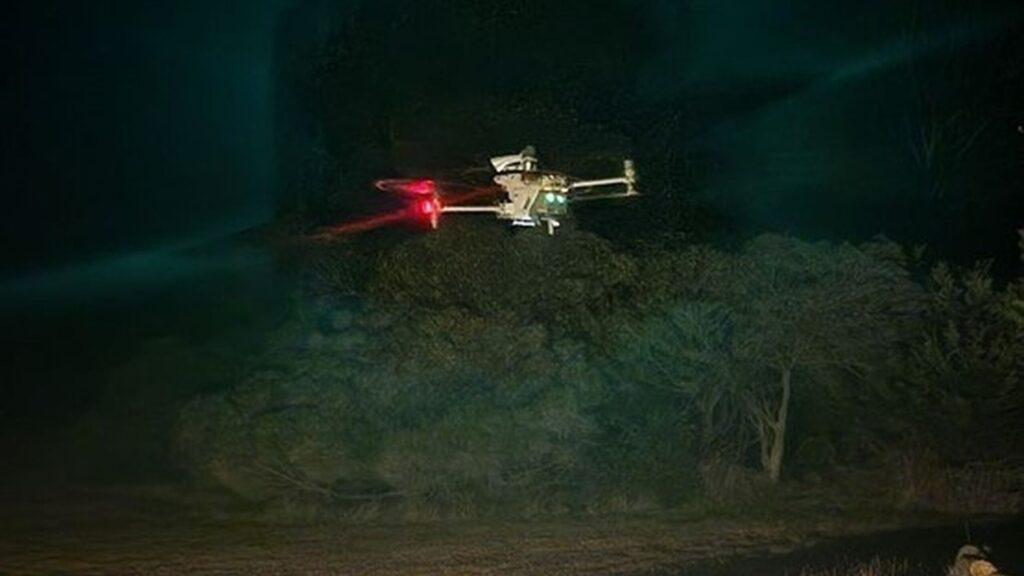
It is the dead of night at a remote facility in the Niger Delta. The perimeter fence runs into darkness. The nearest guard post is hundreds of metres away. A lone fixed camera stares down one angle while the rest of the site sinks into shadow. This is the moment trespassers wait for. What they do not know is that they are already being watched.
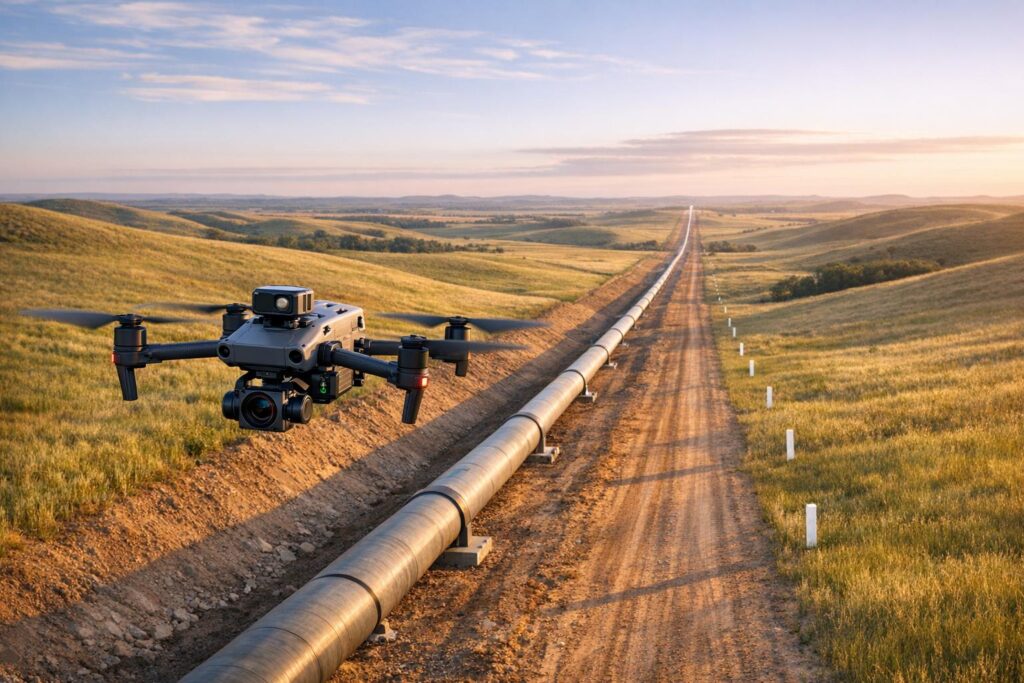
High above, a drone hangs silently in the night sky. Through its thermal camera, the darkness simply does not exist. Two heat signatures glow against the cool earth as they move toward the pipeline. They are visible from hundreds of metres away, tracked with every step, and left with nowhere to hide.
Across Nigeria, this is fast becoming the new standard for protecting critical infrastructure. As threats to pipelines, and the like grow more persistent, the old mix of fences, foot patrols, and floodlights is no longer enough. Security has moved into the air and steadfastly watches the dark.
Why Thermal Drone Security Sees What Guards and Cameras Miss
Traditional site security has always had clear limits. Fixed cameras can only cover the angles they are pointed at, leaving blind spots that intruders learn to exploit within a matter of weeks. Floodlights illuminate small pools of ground but fade quickly across a wide perimeter, while foot patrols move slowly, cover limited distance, and place guards directly in the path of danger. Matters escalate is that nearly all of these measures weaken at night, which is precisely when the risk of intrusion climbs.
Thermal drone security removes these limits altogether. A single drone can sweep an entire perimeter in one flight, unrestricted by fixed angles and untroubled by blind spots. Because its thermal camera reads heat rather than light, neither darkness, smoke, nor dense foliage can conceal a person or vehicle on the ground. One operator, flying from a safe position, can see more of a site in a few minutes than a team of guards could patrol in an hour.
One Drone, Every Sensor: Inside the DJI Matrice 4T
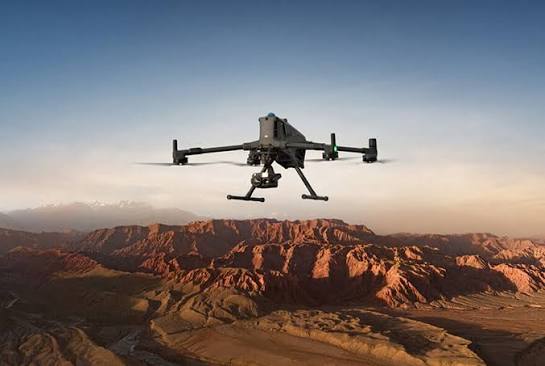
Capturing a threat in the dark takes more than a standard camera. It takes a platform built for the job. The DJI Matrice 4T is that platform.
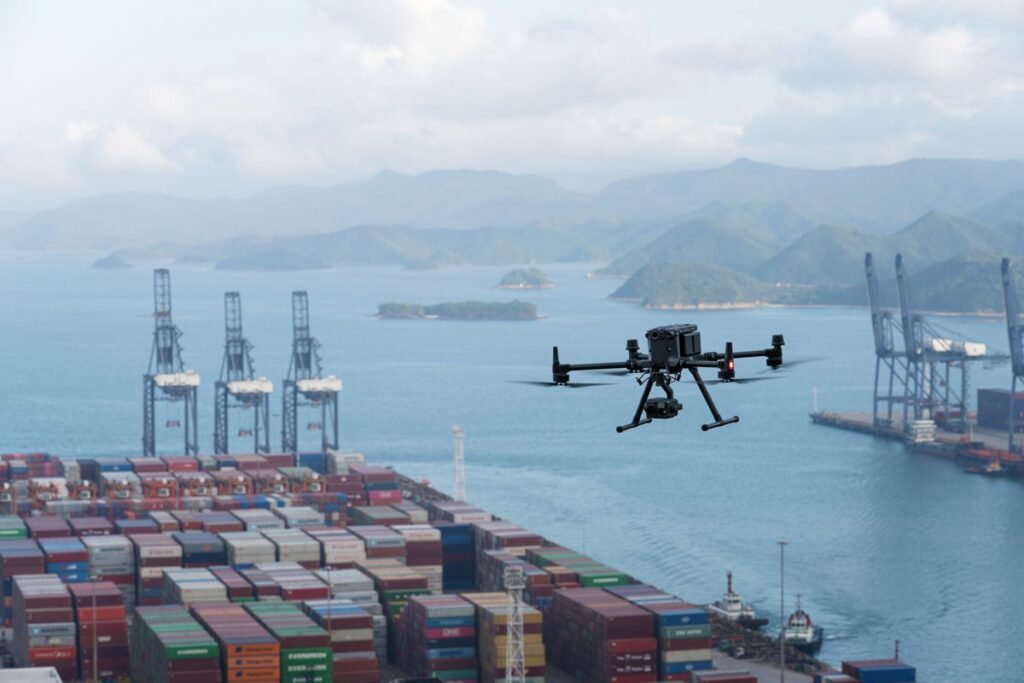
The DJI Matrice 4T carries four cameras, a thermal sensor, and a laser rangefinder on a single gimbal, with every sensor ready at once and no payload to swap. The thermal sensor detects heat signatures through darkness, smoke, and foliage. The telephoto camera offers up to 112x hybrid zoom, enough to positively identify a person or a vehicle from more than 250 metres away. Built-in night vision lights the scene at up to 100 metres in pitch dark. And onboard AI detects people, vehicles, and boats automatically, raising real-time alerts the moment something moves.
Most powerful of all for security work, the laser rangefinder tags a target with precise coordinates from as far as 1,800 metres. A distant figure on a screen becomes an exact location on a map. With up to 49 minutes in the air and deployment in seconds, the Matrice 4T places a persistent, all-seeing watch over a site whenever it is needed.
From Detection to Response
Spotting a threat is only half the job. Acting on it is the other half, and this is where thermal drone security proves its worth.
Because the drone tags every detection with exact coordinates, a sighting becomes an instruction. Response teams no longer search blindly for a rough location. Instead, they move straight to a confirmed point, guided by a live feed from above. The drone stays overhead throughout, tracking movement, updating positions, and keeping responders aware of what lies ahead. This live, responsive role is what separates active security from scheduled monitoring. A mapping flight tells you what a site looked like last week, the kind of scheduled corridor surveillance ARCO delivers with the Matrice 350 RTK. Thermal drone security, by contrast, tells you what is happening right now, and gives your team the means to act before a small intrusion becomes a serious loss.
Built for Nigeria’s Security Realities
Nigeria’s critical infrastructure faces real and persistent pressure. Pipelines are constantly tapped and vandalised. Substations and depots are targeted for theft. Terminals, ports, and remote facilities must be watched around the clock, often across terrain that is hard to patrol on foot. These are not occasional risks. They are daily realities in operations across oil and gas, power, and maritime.
Meeting them takes more than imported equipment flown in for a single job. It takes a capability that is resident, accountable, and run by people who understand the local ground. This is the principle behind ARCO Worldwide. As Nigeria’s first DJI Enterprise Authorized Partner, ARCO delivers aerial surveillance and security across the country’s most demanding environments, combining enterprise drone technology with NCAA-compliant operations and genuine local engagement.
From perimeter protection and intrusion detection to day-and-night overwatch, thermal drone security gives operators something that fences and cameras never could: a watchful eye that moves, sees in the dark, and never blinks.
The threats to Nigeria’s infrastructure do not rest when the sun goes down. Neither should the systems that protect it. With thermal imaging, intelligent detection, and precise location combined in a single compact platform, the security drone has become one of the most effective guardians a site can have.
The question for operators is no longer whether aerial security belongs on their sites. It is how soon they put it to work, and whom they trust to fly it.
Protect your site with cutting-edge thermal drone security from ARCO Worldwide. Our advanced surveillance solutions help detect threats early and enhance overall site safety. Contact us today to learn more.