In May 2026, Nigeria’s own regulators couldn’t agree on how much gas had actually been flared. The Nigerian Upstream Petroleum Regulatory Commission recorded 17.6 million standard cubic feet for the month. The National Oil Spill Detection and Response Agency put the figure at 30.7 million, nearly double. Both numbers came from the same industry, the same month, the same country.
That gap isn’t a rounding error. It’s the clearest evidence yet that gas flaring monitoring Nigeria currently relies on wasn’t built to produce one trustworthy number, let alone two agencies agreeing on the same one.
Why This Number Actually Matters
Gas flaring isn’t a minor line item in Nigeria’s energy accounts. NOSDRA valued the gas flared in the first quarter of 2026 alone at roughly 862 billion naira, or $627 million, gas that could have generated electricity instead of burning off into the atmosphere. Across 2025, flaring wiped out an estimated 32,300 gigawatt-hours of potential power generation, in a country where electricity shortages remain a daily reality.
The federal government has committed to ending routine gas flaring entirely by 2030, alongside a broader net-zero target for 2060. NUPRC’s Chief Executive, Oritsemeyiwa Eyesan, has framed this as commercial strategy as much as environmental policy, concessioning flare sites to firms that can convert wasted gas into usable power instead of simply penalising the practice. None of that works, though, if nobody can agree on how much gas is actually being flared in the first place.
Why Estimates Keep Producing Different Answers
Much of Nigeria’s flaring data still depends on operator-reported estimates rather than independent, measured verification. That’s precisely why NUPRC recently issued a directive pushing the industry toward standardised, measurement-based methane and greenhouse gas reporting, replacing estimation with data operators and regulators can actually stand behind.
Estimates built on assumptions will always drift apart eventually. NUPRC and NOSDRA didn’t reach different numbers because one agency was careless. They reached different numbers because the underlying data wasn’t measured consistently enough for two separate reviews to land on the same figure.
What Aerial Monitoring Actually Verifies
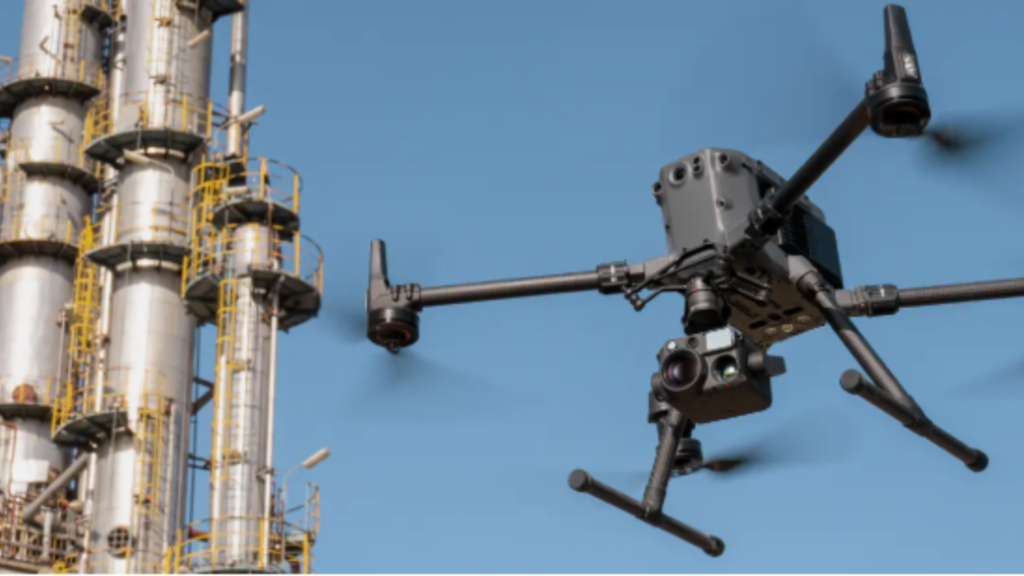
This is where independent aerial data changes the equation. The DJI Matrice 400, paired with the Zenmuse H30T payload, captures high-resolution optical and radiometric thermal imaging of flare stacks directly, recording flare activity, intensity, and duration as located, timestamped data rather than a monthly estimate compiled after the fact.
RTK precision ties every reading to an exact site and moment, which matters enormously when two different reports are already disagreeing on the same period. A flight log showing exactly when a flare was burning, and how intensely, gives operators and regulators alike a shared reference point neither NUPRC’s nor NOSDRA’s current process currently provides. The same instinct is already reshaping how Nigeria verifies infrastructure at scale, and gas flaring deserves the same standard of proof.
From a Single Reading to a Verified Record
A single flight confirms one moment. Scheduled, repeated aerial monitoring across flare sites builds something far more valuable: a running, independently verified record that operators can present to regulators, and regulators can use to reconcile against operator-reported figures, rather than publishing two conflicting numbers and letting the discrepancy stand.
That record matters most as Nigeria’s 2030 target gets closer. A country cannot manage its way to zero flaring using numbers two of its own agencies can’t agree on today.
Built for the Standard This Work Demands
ARCO Worldwide is Nigeria’s first licensed commercial drone operator, authorised by the NCAA, and our operations run under ISO 9001:2015 certified standards. As Nigeria’s authorised DJI Enterprise reseller, we bring the exact inspection and verification capability the gas sector needs to close this data gap, not another estimate, but a measured, defensible record.
Closing the Gap Between Two Numbers
Nigeria’s flaring target isn’t the hard part. Trusting the data behind it is. Two agencies reporting two different figures for the same month is a warning sign the industry can’t afford to ignore much longer.
Considering independent verification for flare monitoring or emissions reporting? Talk to ARCO Worldwide today.