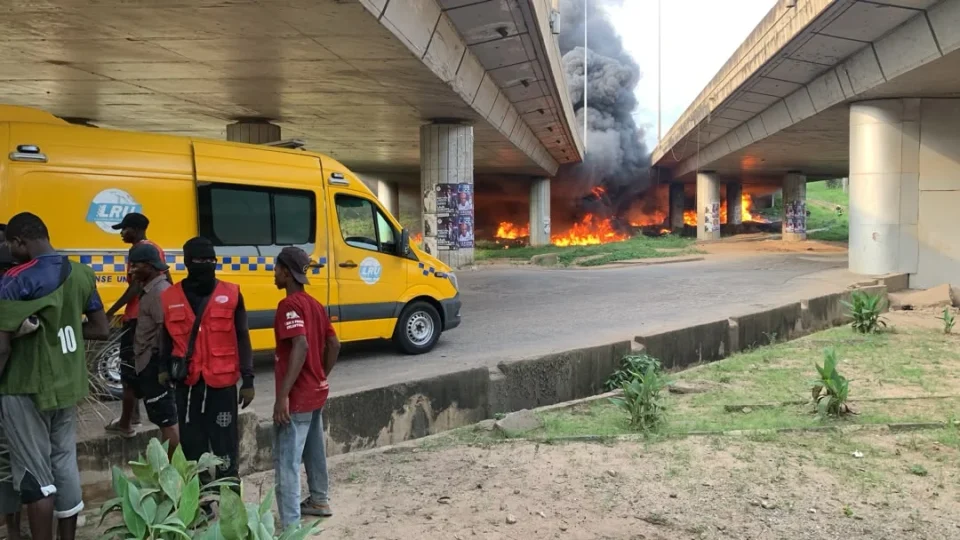
A diesel tanker left the Otedola Bridge on the Lagos-Ibadan Expressway and erupted into a fire beneath the structure. Two people suffered severe burns.
LASTMA, the LASEMA Rescue Unit, the Lagos State Fire and Rescue Service, the FRSC, Neighbourhood Watch and police from Alausa Division mobilised together. They extricated both victims and contained the blaze. That response deserves recognition before anything else is said about the incident.
What follows concerns the question that arrives once the fire is out.
The question nobody can answer from the deck
A severe fire burned directly beneath a bridge carrying one of Nigeria’s busiest corridors.
So the structure now needs assessment. Traffic cannot simply resume on the assumption that concrete and steel came through unharmed, and an engineer standing on the deck cannot see the parts that matter.
That assessment is urgent in both directions. Reopen too early and you accept unknown risk. Keep a corridor like the Lagos-Ibadan Expressway closed longer than necessary and the economic cost compounds by the hour.
What fire actually does to a structure
Heat damages bridges in ways that are not obvious from above.
Concrete spalls when heated rapidly, breaking away from the surface and exposing reinforcement. Reinforcing and prestressing steel lose strength as temperature rises, and some of that loss does not recover on cooling.
Bearings, expansion joints and protective coatings all degrade under heat. Cracking appears around the most heated zones, frequently on the soffit rather than the deck.
Consequently, the evidence of fire damage concentrates exactly where inspection access is hardest.
Why the hardest areas are the ones that matter
Soffits, beams, bearings and pier caps sit where nobody stands comfortably.
Reaching them conventionally means an under-bridge inspection unit occupying a lane, or rope access teams working at height over a live expressway. Both take time to arrange, and both add disruption to a corridor already congested.
Therefore the practical outcome is often a visual check from the deck, followed by a decision made with incomplete information.
What aerial assessment delivers, and how fast
A drone approaches the structure from below and outside, with no lane closure and nobody at height.
Within hours of access being granted, an inspection can document the full soffit, the beams, the bearings, the piers and the abutments. Every finding arrives with imagery attached, so the engineering decision rests on evidence rather than recollection.
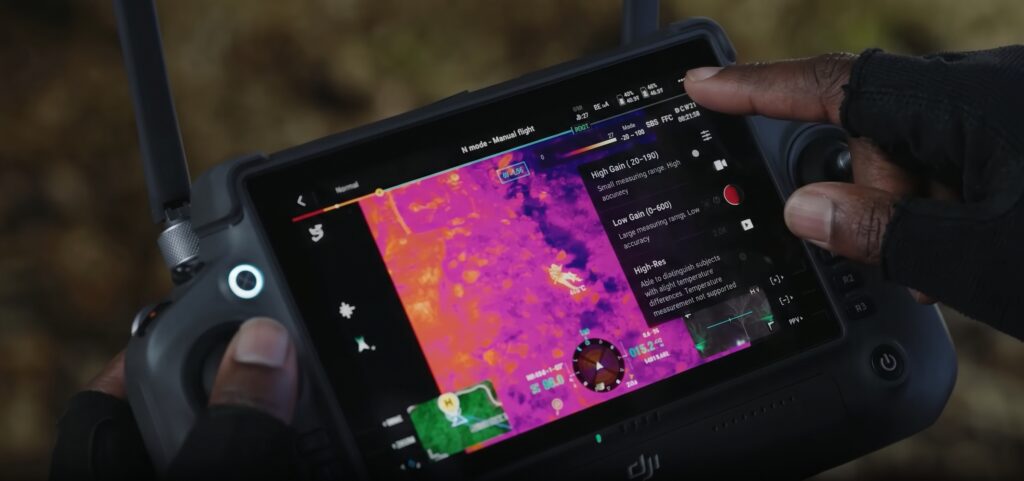
Thermal imaging adds a second layer that matters specifically after a fire. Delamination and moisture ingress often register as temperature difference before they become visible, and heat patterns indicate where the structure absorbed most energy.
Best-fit DJI platform: Matrice 350 RTK with Zenmuse H30T
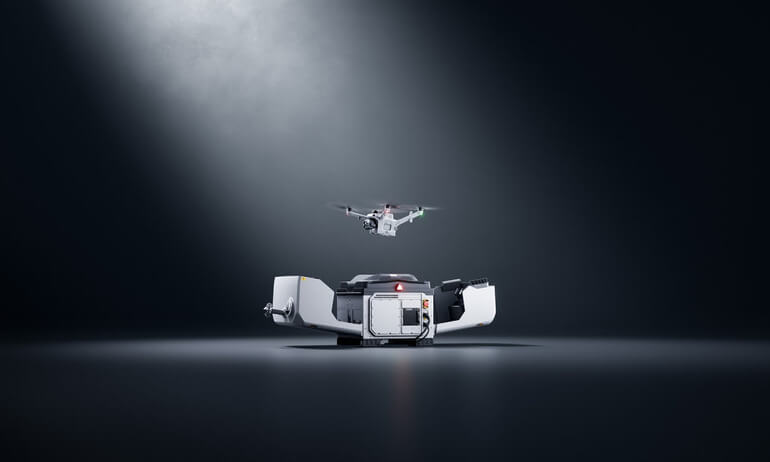
For post-incident structural work, the strongest fit in the DJI Enterprise range is the Matrice 350 RTK paired with the Zenmuse H30T.
The H30T combines 34x optical zoom, thermal imaging and a laser rangefinder. Zoom captures crack width and spalling detail from a safe standoff, which matters over water, live traffic or a recently burned area. Laser ranging records exact position, so defects can be relocated for repair.
The platform supports upward-facing payload mounting, which is what makes soffit and underdeck inspection practical rather than awkward.
Where deformation matters, Zenmuse L2 LiDAR produces point clouds for geometry comparison and clearance measurement. Zenmuse P1 delivers photogrammetric 3D models for the permanent record.
For rapid arrival, the Matrice 4T deploys in minutes and carries thermal alongside its zoom cameras.
Support during an incident, not only after it
Aerial capability also assists while a response is still running.
A live overhead view shows fire ground extent, exposure to surrounding infrastructure, and how traffic is backing up across diversion routes. Command teams receive that picture without committing anyone to a vantage point.
ARCO Worldwide offers this as support to the agencies already doing the work, not as a substitute for them. The people on the ground remain the response. Aerial data simply widens what they can see while deciding.
The preventive argument
This stretch of the Lagos-Ibadan Expressway has recorded repeated crashes, roll-overs and tanker incidents. A tanker overturned at Ojota Bridge only recently.
A corridor with that record warrants a documented structural baseline, captured before the next incident rather than after it. With a prior survey on file, post-incident assessment becomes a comparison instead of a fresh investigation, and change gets measured rather than estimated.
Routine aerial inspection makes that baseline affordable enough to maintain.
Operating properly over public infrastructure
Flying over expressways, water and near controlled airspace requires authorisation and coordination.
ARCO Worldwide is Nigeria’s first licensed commercial drone operator, authorised by the NCAA for nationwide commercial operations and approved by the Office of the National Security Adviser. Our inspection reporting runs under ISO 9001:2015 certified processes, which supports BPP-compliant submissions for public sector work.
With bases in Lagos, Abuja and Port Harcourt, we mobilise to structures quickly.
Answer the question with evidence
Every bridge that survives an incident still has to be proven safe before it carries traffic again.
Bridge inspection in Nigeria works best when that proof is quick, thorough and documented. Aerial survey reaches what matters, records it properly, and gives engineers what they need to decide.
Ready to assess a structure, or establish a baseline before you need one? Talk to ARCO Worldwide today.