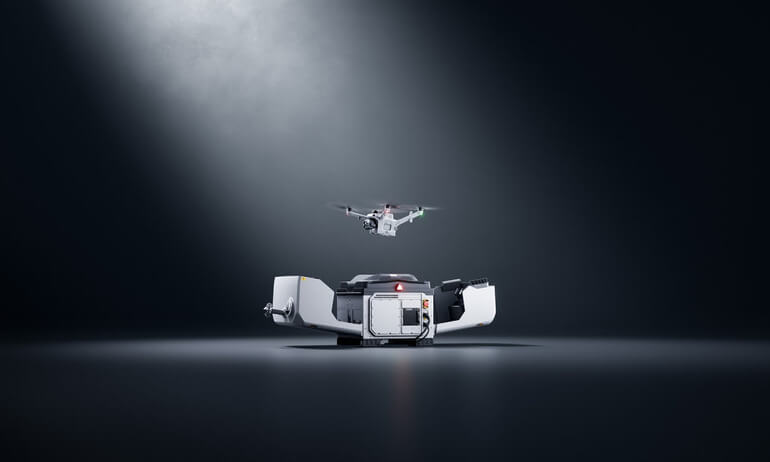
DJI Dock 4: The 25-Second Swap That Changes Everything
Autonomous drone docks solved the crew problem years ago. They never solved the waiting problem.
A drone flies its mission, lands, and then sits. Charging takes time, and during that time nothing is in the air. The DJI Dock 4 removes that pause entirely, and the consequences run further than the specification suggests.
What the DJI Dock 4 actually changes
This is DJI’s first dock with automated battery swapping.
Instead of recharging the aircraft in place, the dock extracts the depleted battery and inserts a fresh one. The whole exchange takes 25 seconds.
Previous generations needed at least 30 minutes between flights. Consequently, a dock could cover roughly half a day’s worth of flying at best. Now the limit shifts from charging speed to the number of batteries available.
The tagline DJI uses is “Always There, Always Ready.” For once, that is a description rather than a slogan.
Why 25 seconds rewrites the arithmetic
Consider what a scheduling gap actually costs.
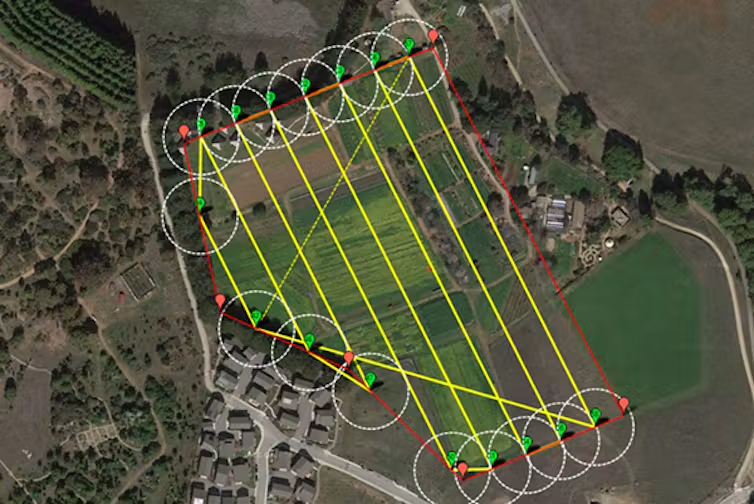
A corridor monitored every two hours is unwatched for most of those two hours. A perimeter patrolled four times a night leaves four windows. Anyone studying the pattern finds them quickly.
With a 25-second turnaround, the aircraft returns to the air almost immediately. Therefore coverage stops being a series of snapshots and becomes something closer to a continuous watch.
For prolonged operations, that difference compounds. A search that runs through the night no longer pauses while a battery charges. A perimeter under active threat stays observed.
How the swap works
The mechanism is simpler than it sounds, and it runs in five stages.
- Approach and landing. The aircraft uses mmWave radar and LiDAR to land precisely on the dock.
- Alignment. The docking mechanism secures the landing gear and aligns the battery bay.
- Extraction. A robotic arm removes the depleted battery.
- Insertion. A charged battery from the internal carousel goes in, completing the physical swap.
- Relaunch. The aircraft takes off again while the dock charges the battery it just removed.
Each cycle feeds the next. So the system sustains itself without anyone attending it.
The aircraft: DJI Matrice 5TD
The dock houses the DJI Matrice 5TD, and the airframe matters as much as the enclosure.
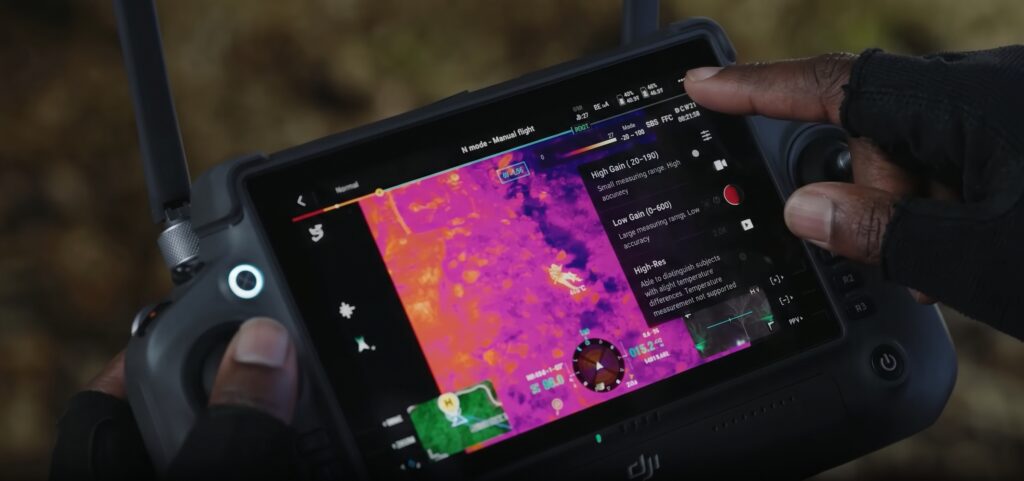
It carries wide-angle and infrared cameras, which covers both daylight detail and night operations. Thermal is not an optional extra here. Most security incidents happen after dark, and most thermal anomalies on industrial assets appear before visible failure does.
Navigation relies on mmWave radar and LiDAR together. That combination supports obstacle avoidance and precision landing, which is what makes unattended operation realistic rather than theoretical.
Onboard edge AI detects and tracks up to 17 object types. In practice, that means the system flags vehicles, people and hazards itself, rather than producing footage for somebody to review afterwards.
Airborne on alert
Response time is where the platform earns its place in public safety work.
The aircraft launches the moment the dock cover opens. It then transits at up to 21 metres per second, roughly 76 kilometres per hour, ignoring road conditions entirely.
For a first responder, that usually means aerial eyes arrive before ground crews do. Command receives live video while units are still moving, which changes what those units know on arrival.
The software layer
Hardware alone would only automate the flying.
DJI FlightHub 2 manages routes, coordinates fleet data and streamlines the operational workflow. The DJI O4 Ground Station extends transmission and penetration, which matters on complex sites where signal paths are obstructed.
Together they turn a dock into a monitoring system rather than an unattended aircraft.
What the DJI Dock 4 means for Nigerian operations
Several applications here benefit immediately.
Pipeline corridors and tank farms need coverage that does not pause overnight. Transmission networks and substations need repeat inspection without crew travel. Mining concessions face encroachment that daytime patrols never see.
Port terminals, telecom sites and industrial estates all share the same requirement: the same route, flown often, for a long time.
Emergency response is the newer case. Flood assessment, fire response and incident verification all reward aerial information arriving in minutes rather than hours.
Deploying it properly
Automated and beyond visual line of sight operations require NCAA authorisation, documented procedure and qualified oversight. A dock does not change that, and the approvals question belongs before the hardware question.
ARCO Worldwide is Nigeria’s first licensed commercial drone operator, authorised by the NCAA and approved by the Office of the National Security Adviser, with BVLOS-capable operations under ISO 9001:2015 certified processes.
As Nigeria’s first and only DJI Enterprise Authorized Reseller and Enterprise Solutions Partner, we supply, configure and commission DJI systems, then train your team through ARCO Aviation Academy. Alternatively, our Drone as a Service model delivers the coverage with no capital purchase at all.
Ready to assess whether your site suits continuous coverage? Talk to ARCO Worldwide today.