Pipeline Surveillance in Nigeria: Closing the Patrol Gap
A pipeline runs for kilometres through creeks, farmland and bush. A patrol vehicle reaches it twice a week. Between those visits, nobody is watching.
That gap is where most losses begin. Bunkering teams study patrol rhythms, and they move when the corridor goes quiet. Effective pipeline surveillance in Nigeria has to remove that quiet window entirely.
Why patrol-based monitoring keeps failing
Ground patrols were never designed for terrain like the Niger Delta. Roads flood. Access routes close. One team can only cover so much ground in a single shift.
Helicopter patrols solve the reach problem, but they carry heavy cost. As a result, most operators fly them rarely. Rare flights create long blind windows, and blind windows are exactly what illegal tapping depends on.
Scheduled drone missions improve the picture. However, they still leave gaps between rotations. The real question is not whether a drone flies. It is what happens on the days it does not.
What continuous pipeline surveillance in Nigeria looks like
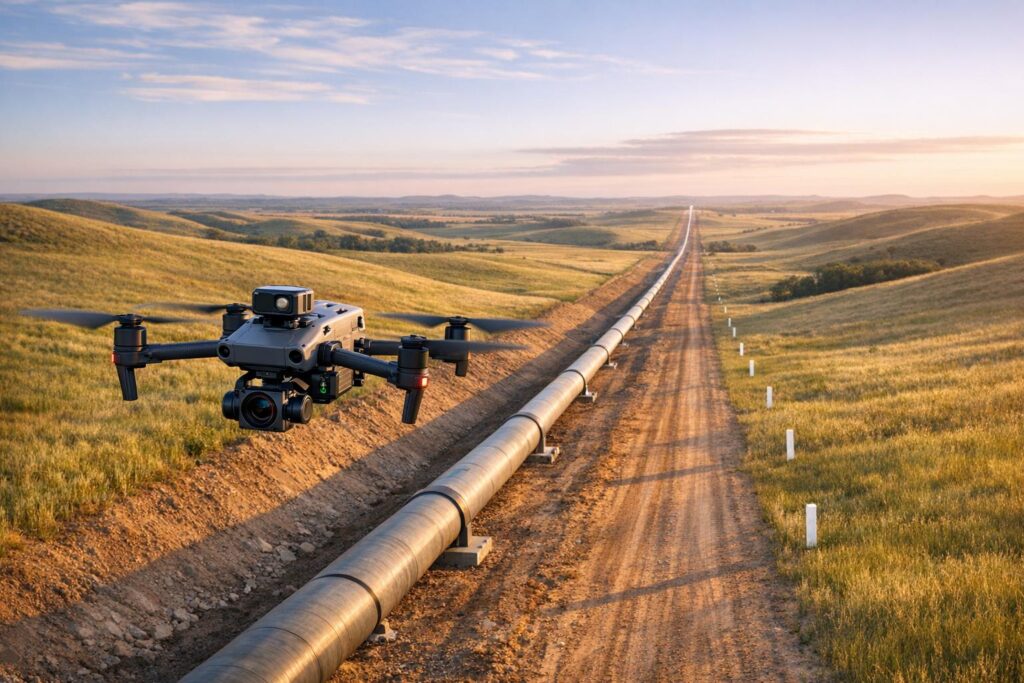
Continuous coverage means the corridor is flown on a fixed cycle, every day, without a crew driving to site. Missions launch automatically. The aircraft follows the same route, records the same reference points, then returns to charge.
Because the route repeats, change becomes obvious. Fresh excavation near a right of way stands out immediately. A vehicle parked where no vehicle belongs triggers an alert. In short, the system flags what is different instead of waiting for someone to notice.
Best-fit DJI platform: Matrice 4TD with DJI Dock 3
For corridor monitoring, the strongest fit in the DJI Enterprise range is the Matrice 4TD paired with DJI Dock 3.
The dock houses, charges and launches the aircraft with no pilot on site. It carries an IP56 rating, while the aircraft holds IP55 protection. Therefore the system keeps flying through rain, dust and heat that would ground a conventional crew.
The Matrice 4TD carries a thermal and wide-angle payload set built for night work. Its infrared sensor picks up heat signatures along a corridor after dark, which matters because most interference happens at night. Transmission reaches up to 25 kilometres, so one dock covers a meaningful stretch of line.
Through FlightHub 2, missions run on schedule or on trigger. In addition, automated detection flags vehicles, vessels and temperature anomalies without anyone watching a live feed.
When a crewed platform still makes sense
Some tasks need a heavier aircraft. For long-range sweeps, incident response and close asset inspection, we deploy the Matrice 350 RTK with the Zenmuse H30T payload. It combines zoom, thermal and laser ranging in one gimbal. Consequently, a single sortie can sweep a corridor and inspect a specific fitting.
What operators actually receive
Hardware alone does not protect a pipeline. Under our Drone as a Service model, ARCO Worldwide delivers:
- Scheduled corridor coverage with timestamped imagery
- Change-detection reports showing new encroachment or excavation
- Thermal night coverage across high-risk segments
- Live command support during active incidents
- Encrypted data handling and audit-ready records
You focus on production. We manage the aviation.
Operations built to the required standard
ARCO Worldwide is Nigeria’s first licensed commercial drone operator, authorised by the NCAA and approved by the Office of the National Security Adviser. Our operations run under ISO 9001:2015 certified processes. We are also Nigeria’s only DJI Enterprise Authorized Reseller and Solutions Partner.
That combination matters. Regulatory clearance, BVLOS capability and certified crews are what turn a drone into a working pipeline surveillance system.
Stop depending on timing
Every recovered-pipeline story contains the same detail. Someone reached the site in time. Continuous pipeline surveillance in Nigeria removes that dependency, because the corridor is never left unwatched.
Ready to close the gap across your network? Talk to ARCO Worldwide today.