Nigeria wastes roughly 38 million tonnes of food every year. That figure tops every other country on the continent, according to recent National Bureau of Statistics and European Union data. The waste carries a value close to five trillion naira. Meanwhile, the FAO estimates that 27 to 34 million people face acute hunger in the same country.
The two facts sitting side by side aren’t a contradiction. They’re a supply chain problem. Farmers routinely sell immediately after harvest, often at rock-bottom prices. They do this to avoid spoilage they had no way to plan around. That’s precisely the gap crop yield estimation Nigeria farms need has to close. And it has to close before harvest day, not after.
Why Farmers Sell Low Right When Supply Peaks
Post-harvest loss doesn’t start at the point of spoilage. It starts weeks earlier. At that stage, a farmer still has no reliable estimate of how much crop is actually coming in. Without that number, there’s no way to arrange storage capacity, line up buyers, or schedule transport in advance. Everything happens reactively, all at once, right as the harvest lands.
That reactive scramble is exactly what drives prices down. Farmers across a region all sell at the same moment because none of them planned ahead. Buyers then hold the leverage. A harvest that took a full season to grow sells in days, often below the price it deserved.
What Gets Missed Without an Early Estimate
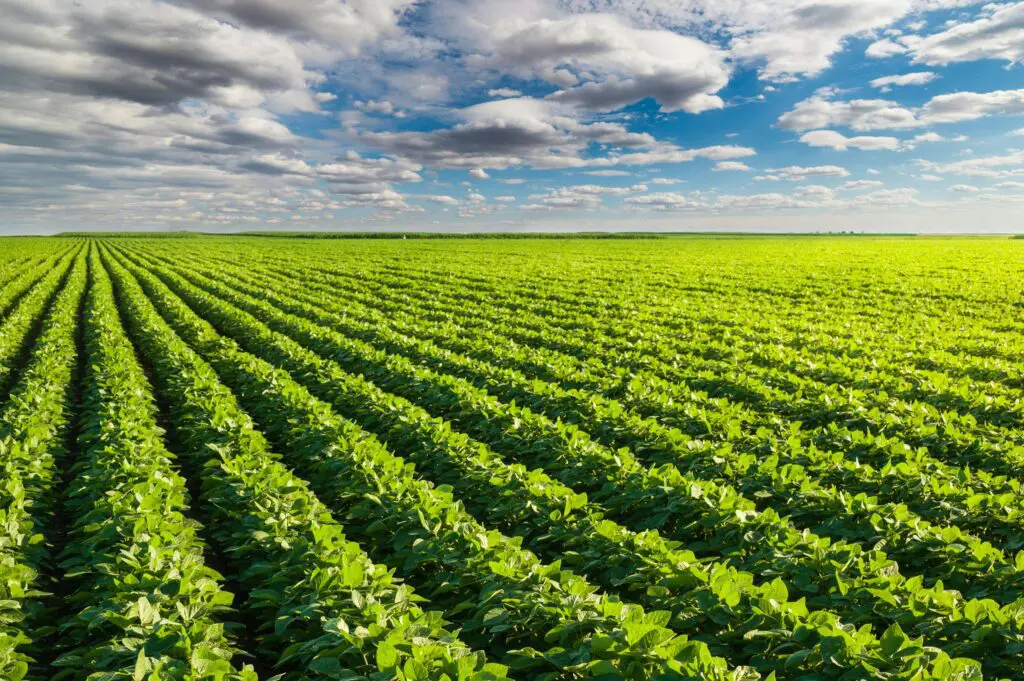
A farmer walking a field close to harvest can make a rough visual guess. But a guess isn’t the same as a measurement. Larger farms and cooperatives face the same problem at greater scale. Uneven growth across hundreds of hectares makes an accurate, field-wide estimate essentially impossible to produce by eye.
That uncertainty compounds every decision downstream. Farms book storage facilities too late, or not at all. They approach buyers without a credible volume to negotiate around. They arrange transport in a rush instead of scheduling it efficiently. Every one of those failures traces back to the same missing piece. It’s a reliable number, early enough to act on.
How Aerial Mapping Actually Produces That Number
This is where multispectral aerial data changes what’s possible weeks before harvest. The DJI Matrice 350 RTK carries a multispectral sensor across an entire field. That sensor captures crop biomass and canopy health data. The result translates into yield estimates far more accurate than a visual walk-through. NDVI analysis maps exactly where a crop is thriving and where it’s underperforming. It gives a field-wide picture instead of a handful of sampled points.
Larger commercial farms and cooperatives need wider coverage. The DJI Matrice 400 extends that same mapping across bigger growing areas in a single flight. It produces an estimate for an entire holding. Nobody pieces together partial data from whatever section someone managed to walk.
From a Single Estimate to a Planning Tool
A single flight close to harvest gives a farm a number to work with. Fly earlier and repeat through the growing season, and that same data becomes far more valuable. It turns into an evolving forecast. Storage providers, buyers, and transport partners can then plan around it in advance.
That shift changes what yield estimation means. It stops being a nice-to-know figure. Instead, it determines whether a harvest sells at a fair price. The alternative is what so much of Nigeria’s food currently meets: a market that floods all at once.
Built for the Standard This Work Demands
ARCO Worldwide is Nigeria’s first licensed commercial drone operator. The NCAA authorises our flights, and our operations run under ISO 9001:2015 certified standards. We are also Nigeria’s authorised DJI Enterprise reseller. So we bring the exact multispectral and mapping capability farms need. That capability turns a harvest guess into a plannable number through the season.
The Number That Should Have Come Weeks Earlier
Thirty-eight million tonnes doesn’t go to waste because Nigeria’s farms lack effort. It goes to waste for a simpler reason. Too many farms find out how much they’ve grown at the exact moment they need to sell it.
That’s the timing problem aerial yield estimation solves.
Ready to know your harvest before it arrives? Talk to ARCO Worldwide today.