A single loose connector begins to heat up. Left unseen, it will arc, fail, and pull a section of the network down with it. As a result, homes and businesses lose supply, and they may wait hours, or days, for it to return. The fault is small, but the consequences are not. This is the daily reality of running critical infrastructure across thousands of kilometres. Here, the difference between a minor repair and a major outage often comes down to one thing: time.
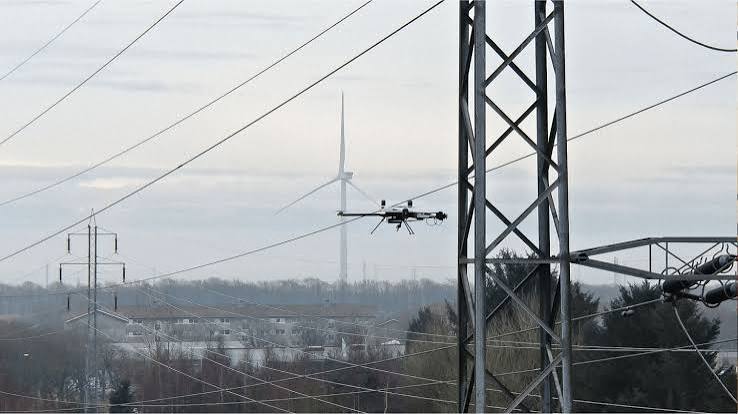
Power infrastructure drone inspection is changing what operators can see, and when. It places an intelligent aerial eye over generation plants, transmission corridors, and distribution networks. In turn, it converts invisible, developing faults into clear, early warnings. For a sector under constant pressure to improve reliability and cut losses, that visibility is fast becoming essential.
The High Cost of Not Seeing
Most developing countries possess vast and ageing electricity networks under strain. Their assets stretch across difficult terrain, exposed to weather, vegetation, theft, and simple wear. Consider the operators who run them, from generation companies to the transmission and distribution firms that carry power to the customer. For all of them, the greatest challenge is often knowledge itself. After all, you cannot fix what you cannot find.
Traditional inspection struggles here. Sending crews to climb towers, walk corridors, and check remote plant infrastructure is slow, costly, and dangerous. Moreover, it covers only what a team can physically reach. Worse, it captures a single moment rather than a developing trend. Too often, the first sign of a fault is the outage it causes. By then, the cost has already landed on the operator and the public alike.
Power Infrastructure Drone Inspection, From Plant to Pole
This is where a power infrastructure drone inspection replaces uncertainty with clarity. At the heart of it sits a compact, sensor-rich platform such as the DJI Matrice 4T. Impressively, it carries an entire inspection toolkit on a single airframe.
The thermal camera is key. Electrical faults reveal themselves as heat long before they fail. The M4T reads that heat precisely, flagging an overheating joint, a failing insulator, or a hot transformer that looks normal to the naked eye. A high-magnification zoom then inspects fine detail from a safe distance. Meanwhile, onboard AI helps identify assets and anomalies, and a laser rangefinder fixes the exact location of a fault for the repair crew. In one flight, then, an operator sees not just where an asset is, but how healthy it is.
Value Across the Entire Grid
The same capability serves every link in the power chain.
For generation companies, it inspects plant infrastructure, switchyards, and cooling systems. It spots problems in hard-to-access structures without shutting operations down. Transmission networks gain too. Here, the drone delivers corridor monitoring, tower inspection, and fault detection across long, remote lines. In hours, it covers what crews would take days to walk. Distribution companies benefit as well. For them, it brings cost-effective, last-mile monitoring and fast fault location, restoring supply to customers sooner and at lower cost.
Renewable energy developers gain just as much. On a solar farm, a single thermal sweep reveals underperforming or failed panels across thousands of modules. In doing so, it protects both output and revenue. For wind assets, aerial inspection checks blades and structures for damage that is difficult and dangerous to reach by hand. In every case, the operator gains accurate, current data on the assets that earn their keep.
From Inspection to Predictive Intelligence
The real strength of a power infrastructure drone inspection lies beyond any single flight. When aerial data is captured regularly and run through sensor-driven analytics, inspection becomes intelligence. As a result, operators can track how an asset changes over time. They can also compare its condition against past surveys, and anticipate failures before they happen.
This is the shift from reactive repair to predictive maintenance. Instead of responding to outages, operators schedule work on their own terms, targeting the assets that need attention most. The same aerial capability can also pair with a rapid incident alert system. Then, it flags emerging faults and threats as they arise. In turn, control rooms gain the early warning they need to protect supply and keep critical infrastructure running.
Independent Data for Oversight and Trust
Accurate condition data does more than guide maintenance. It builds trust. Regulators and oversight bodies need an independent, reliable view of the nation’s power infrastructure, free from guesswork and self-reporting. Aerial inspection provides exactly that: objective, time-stamped, high-resolution evidence of asset condition across the network. Ultimately, for a sector working hard to improve transparency and accountability, such independent data is a valuable foundation. It supports compliance, oversight, and fair decision-making.
A Nigerian Partner for Nigeria’s Grid
Nigeria’s energy challenges are demanding and local, and the response should be too. Keeping the lights on calls for partners who understand the terrain, the assets, and the rules of Nigerian airspace. Above all, it calls for partners who can be on site when it matters most.
This is where ARCO Worldwide stands ready. The company supports energy and utility operators with aerial intelligence and sensor-driven analytics. These tools optimise asset performance, enable predictive maintenance, and safeguard the continuity of critical infrastructure. From a single plant inspection to network-wide power sector monitoring, ARCO gives operators the clarity they deserve. With it, they can run a safer, more reliable grid.
Nigeria’s power sector carries the weight of the nation’s growth. Seeing clearly is the first step to carrying it well.